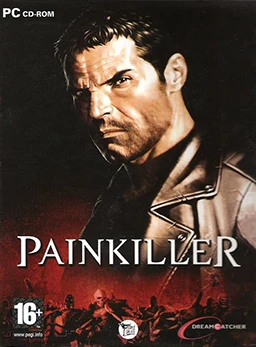
The Fire
Where Hell stops smoldering and starts consuming everything in its path.

The Fire is a searing, infernal region of Hell that serves as a recurring environmental setting across the Painkiller franchise. As one of the most visually dominant zones Daniel Daimio must traverse, it embodies the raw, unrelenting torment of the demonic realm—endless columns of flame, rivers of molten rock, and architecture that seems to be perpetually consumed by its own heat.
Rather than a single static map, The Fire functions as a thematic and atmospheric layer woven through multiple levels and encounters. It is where the heat of Hell is most extreme, where the ground itself glows with magma, and where the demons that dwell there are often larger, more aggressive, and more numerous than in the cooler, more structured parts of the underworld.
- Setting
- Hell (demonic realm)
- Franchise
- Painkiller
- Protagonist who traverses it
- Daniel Daimio
- Primary hazard
- Sustained flame, lava, and heat-based environmental damage
- Enemy type
- Various demons and hellspawn
- Atmosphere
- Infernal, oppressive, visually overwhelming
Lore & Background
In the cosmology of the Painkiller games, Hell is not a single uniform plane but a layered underworld of distinct regions, each with its own character and degree of torment. The Fire occupies the most volatile of these strata—a zone where the elemental heat has reached a kind of saturation, where the very air shimmers and the ground is a lattice of glowing cracks over rivers of molten material. It is here that the architecture of Hell appears most broken, as though the structures were built and then the fire simply refused to stop growing.
Daniel Daimio, the demon hunter, must push through these burning corridors and open pits to reach deeper objectives. The Fire is not merely a backdrop; it is an active participant in the combat. Pools of lava, falling embers, and walls that ignite under sustained fire create a battlefield where the environment itself threatens the hunter as much as the demons do. The heat is a constant, oppressive presence that the player feels in the way the camera shakes, the way the palette shifts to deep oranges and blacks, and the way the audio swells with the roar of uncontrolled flame.
Within the broader narrative of the franchise, The Fire represents the raw, unstructured fury of Hell before the more organized, almost bureaucratic evil of its upper tiers. It is the place where the demonic realm is most honest in its cruelty—no trickery, no feigned hospitality, just the endless, consuming burn.
In Their Own Story
The air tasted of sulfur and old ash. Daimio's boots crunched on a crust of cooled slag that split open beneath his weight, and a tongue of white-hot lava licked up around his ankle before he hopped clear. Ahead, the corridor opened into a vast chamber where the ceiling had collapsed into a canopy of drifting embers, each one the size of a fist, each one leaving a faint trail of smoke. The demons there did not charge. They simply stood in the glow, watching, as though they had all the time in the world and the fire would do the rest. He racked his shotgun. The fire, he decided, could wait.
Reader's Guide
The Fire's visual identity is defined by extreme contrast: deep black rock veined with incandescent orange, columns of flame that reach beyond the top of the screen, and pools of molten material that cast a low, pulsing light across every surface. The palette is almost exclusively warm—reds, oranges, yellows—punctuated by the black of charred stone and the pale blue-white of the hottest flame cores. Particles of ash and ember drift constantly through the air, catching light and adding depth to otherwise dark spaces.
Gameplay in these areas emphasizes verticality and spatial awareness. Lava pools and open flame corridors act as environmental hazards that punish reckless movement, while demon enemies—often in larger packs than in cooler zones—use the smoke and heat distortion to close distance. The player must manage positioning carefully, using the burning architecture both as cover and as a threat to avoid.
Narratively, The Fire marks a transitional phase in Daniel's journey: the point where Hell stops being a place he can navigate with some degree of order and becomes a force that actively resists his passage. It is a threshold of intensity.
Fans have noted that the fire particle effects in these zones are among the most computationally heavy in the games, and that certain angles in the open chambers reveal the geometry of the level design in ways that break the infernal illusion, a small reminder of the digital scaffolding beneath the flames.
Did You Know?
- The Fire environments in Painkiller rely heavily on dynamic particle systems for embers and ash, making them among the most visually dense and performance-intensive areas in the franchise.
- In the Painkiller games, the fire-based zones often feature enemies that are more numerous and aggressive than those in the cooler, more structured areas of Hell, shifting the gameplay toward sustained combat rather than
- The visual design of the fire areas uses a limited warm-color palette to create a sense of oppressive heat, with the player's own flashlight or weapon glow providing the only cool-toned contrast in the scene.
- Daniel Daimio's traversal through the fire zones is a recurring narrative beat across multiple Painkiller titles, reinforcing the idea that Hell's heat is a constant, inescapable element of his role as a demon hunter.
More in World & Locations
Elsewhere in the Painkiller universe
Spotted an error? Know more?
This is a living reference — every entry is fact-audited, and reader corrections feed straight into our audit queue. Suggest an edit · See this site's audit record