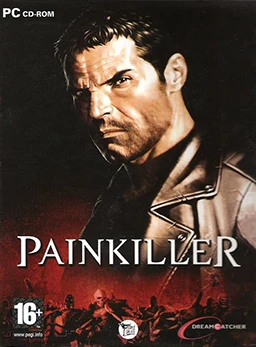
Hell's Gate
The iron door swings open and the dead stop screaming.

Hell's Gate is the threshold location in the Painkiller franchise where the mortal realm bleeds into the infernal. Serving as the entry point into hell, it is the first major zone the player confronts, establishing the oppressive, gothic-horror tone that defines the series. The architecture is a fusion of broken cathedral spires, massive iron portcullises, and rivers of molten rock, all under a sky choked with ash and ember-light.
In the narrative, Hell's Gate is where Daniel Dax, the Hell Knight, is drawn or thrust into the demonic war. It functions as both a literal doorway and a symbolic severing from the world he knew, marking the point of no return in his descent. The location appears across the franchise's entries, evolving in scale and design from the original Painkiller through Painkiller: Hell & Damnation.
- Franchise
- Painkiller
- Type
- Location / Level (gateway to Hell)
- Setting
- Hell — the boundary between mortal and infernal realms
- Protagonist present
- Daniel Dax (Hell Knight)
- Developer
- People Can Fly
- Tone
- Gothic-horror, industrial, oppressive
Lore & Background
In the mythology surrounding the Painkiller games, Hell's Gate is not merely a place but a wound in the fabric between worlds. The gates were forged in an age before the current demon hierarchy consolidated its rule, and they have been breached, sealed, and breached again across countless cycles. Each time a Hell Knight is summoned through, the gate groans and the surrounding landscape shifts, as though hell itself resents being entered by something that can wound it.
The architecture of the gate is deliberately contradictory: ornate, almost sacred stonework carved with script that predates any known human language, wrapped in industrial iron and chain, set against a backdrop of raw geological violence. This juxtaposition is a recurring visual thesis of the series — the sacred and the profane, the built and the natural, locked in perpetual tension. The gate does not open for the demon lord; it opens for the Knight, and that distinction matters to the entities on the other side.
Over the course of the franchise, the gate's condition deteriorates. Cracks widen. The iron rusts and re-forges itself. In later entries the gate is less a single structure and more a sprawling, broken district, suggesting that hell's frontier with the mortal world has been eroded by repeated incursions. The narrative implication is that every Hell Knight who walks through leaves a scar, and the gate is slowly being unmade.
In Their Own Story
The smell hits first — not fire, but wet iron and old blood. Daniel Dax feels the pull before he sees the gate: a hook behind his sternum, tugging him forward across a field of black glass. The portcullise is already half-raised, grinding on tracks that weep molten slag. Beyond it, the sky is the color of a bruise three days old, and something vast is breathing in the dark. He does not draw his weapon. He does not need to. The gate knows him. The gate always knows him. He steps through, and behind him the iron slams shut with the finality of a coffin lid, and the sound of the other side — the quiet, ordinary, *safe* other side — is swallowed whole.
Reader's Guide
Hell's Gate presents as a colossal, half-collapsed gateway complex. Think gothic cathedral architecture fused with industrial foundry: massive iron doors on rusted tracks, flanked by broken buttresses and chains thick as redwoods. The ground is cracked basalt with veins of glowing magma. The sky is a low, churning ceiling of ash and ember. Lighting is harsh and directional — shafts of orange firelight cutting through darkness, with deep blue-black shadows in the crevices.
Gameplay-wise, the gate area serves as an early-to-mid combat zone. You will encounter standard demon infantry (brute-type melee demons, ranged spitters) in tight corridors and open courtyards. Hazards include lava channels that block paths, crumbling platforms, and environmental fire that damages over time. The level design uses the gate's verticality — you fight on the approach, through the threshold, and into the space beyond, with the architecture forcing you through chokepoints before opening into wider arenas.
Narratively, the gate is the inciting location: it is where the player's descent into hell is made literal and irreversible. It sets the tone, introduces the enemy types, and establishes the visual language the rest of the game builds on.
Fans have noted that in the original Painkiller, the gate's background architecture contains faint, almost subliminal iconography resembling inverted religious frescoes. In Hell & Damnation, the gate area is more explorable, with side passages that offer optional combat encounters and weapon pickups. The grinding sound of the portcullise is a recurring audio motif that players associate with level transitions.
Did You Know?
- The Painkiller franchise was developed by the Polish studio People Can Fly, known for its distinctive first-person shooter mechanics including the Painkiller weapon that fires a shockwave.
- Daniel Dax, the Hell Knight protagonist, was originally conceived as a character who could be summoned by a specific ritual, tying the gate's 'opening' to a narrative mechanism rather than random intrusion.
- The franchise's visual identity blends gothic horror with industrial design, a contrast that is most starkly embodied in the gate's architecture — sacred stonework wrapped in functional iron.
- Painkiller: Hell & Damnation (2012) expanded the series' scope with more open, interconnected areas, and the gate concept evolved from a single level into a broader district of hell's frontier.
More in World & Locations
Elsewhere in the Painkiller universe
Spotted an error? Know more?
This is a living reference — every entry is fact-audited, and reader corrections feed straight into our audit queue. Suggest an edit · See this site's audit record