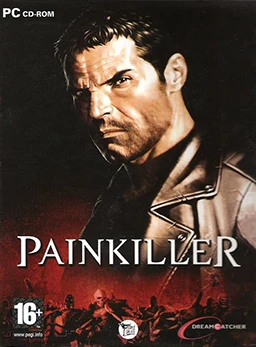
Roman
One sword, one gun, one man against the entire underworld.

Roman is the protagonist of the Painkiller first-person shooter franchise, a warrior defined by his twin weapons—a cursed blade known as the Painkiller sword and a powerful firearm—and his ability to transform into a colossal 'Mega' form. Across the series, he serves as the player's avatar, thrust into a war between his world and the hordes of the demonic underworld.
His role is that of a lone, relentless fighter: the games cast him as a one-man army advancing through layered realms of hellish architecture, clearing waves of demons, and confronting the forces that threaten to consume his world. He is less a character with a deep personal arc than an archetype of mythic, sword-swinging vengeance, and the narrative exists primarily to justify the escalating spectacle of his combat.
- Character
- Roman
- Role
- Protagonist / Warrior
- Franchise
- Painkiller
- First appears
- Painkiller (2004)
- Primary weapons
- Painkiller sword, firearms
- Signature ability
- Mega (giant) transformation
- Developer (2004)
- Flying Wild Hog
Lore & Background
In the mythology of Painkiller, Roman is a warrior of extraordinary strength and resolve, bound to a blade that channels a dark, almost sentient power. The sword—referred to simply as the Painkiller—grants him the capacity to cleave through demonic flesh and, when fully unleashed, to swell his body into a towering Mega form capable of crushing entire legions. This power is not without cost; the blade's energy feeds on the violence it inflicts, and Roman's existence is inextricable from the act of killing.
The world he defends is a layered fantasy realm whose lower strata overlap with the domains of demons. When the barriers between realms fracture, hordes pour upward, and Roman is the one who walks back down into the dark. The narrative frames his campaign not as a quest for knowledge or alliance but as a solitary march through increasingly hostile architecture—cathedrals of bone, rivers of fire, fortresses of obsidian—where every corridor is a battlefield and every gate guards a worse one.
Across the franchise's entries, Roman's personal backstory remains deliberately sparse. He is a symbol more than a person: the idea that a single, unyielding warrior can hold the line where armies fail. The games lean into this by giving him no companions, no dialogue partners of consequence, and no retreat. He enters, he kills, he advances, and the world holds for one more day.
In Their Own Story
The gate shuddered open and the stench hit first—sulfur and old blood, the kind that coats the back of the throat. Roman did not slow his stride. The Painkiller sword hummed in his right hand, its edge drinking the dim light of the corridor, and the pistol in his left was already warm, already eager. Ahead, the archway opened onto a vast hall of black stone, and from every shadow a pair of eyes ignited, amber and hungry. He spat, shouldered the blade, and walked in. The Mega form waited in his blood like a second heartbeat, patient, coiled, ready to tear the ceiling off if the sword was not enough. It would be enough. It was always enough. That was the whole point.
Reader's Guide
The campaign structure in Painkiller is built around Roman's linear advance through a series of themed demonic realms. Early levels introduce his core kit—sword melee, ranged firearm, and the ability to charge up the Mega transformation—while the level geometry shifts from tight corridors to open arenas, mirroring the escalation from individual skirmishes to mass hordes.
As Roman progresses, the environment tells the story: crumbling altars, rivers of molite, and vast bone-cathedrals signal that he is descending deeper into the underworld's architecture. Each major gate or boss encounter marks a narrative beat where a specific demonic lord or champion is defeated, reinforcing the idea that Roman is systematically dismantling the hierarchy that holds the realms together.
The Mega transformation is both a gameplay mechanic and a story device. When Roman swells into his giant form, the level design shifts to accommodate verticality and area-of-effect combat, and the narrative frames it as the sword's power fully manifesting—his personal myth made literal. The final confrontations place him against the largest threats in the most architecturally grand spaces, so that the player experiences the climax as a physical, spatial event as much as a narrative one.
Beyond the individual levels, the broader mythology positions Roman's fight as a recurring, almost cyclical war. The demons are not a single army with one king; they are a force, a pressure, a tide. Roman does not 'win' so much as push the tide back. The stakes are the continued existence of his world, and the cost is his own humanity, eroded with every swing of the blade.
Did You Know?
- The 2004 Painkiller was developed by Flying Wild Hog, a Polish studio, and became a cult hit for its blend of sword-and-gun FPS combat with a 'Mega' giant-transformation mechanic.
- The 2012 reboot was developed by People Can Fly, the same studio behind Gears of War, and reimagined Roman's story with a more grounded, cinematic tone.
- Painkiller: Hell & Damnation (2016), a standalone expansion developed by Flying Wild Hog, expanded the lore by introducing new demonic realms and a deeper look at the mythology behind Roman's sword.
- The 'Mega' mode, where Roman grows to a colossal size, has become one of the franchise's most iconic and frequently referenced features across all mainline entries.
More in Story & Campaigns
Elsewhere in the Painkiller universe
Spotted an error? Know more?
This is a living reference — every entry is fact-audited, and reader corrections feed straight into our audit queue. Suggest an edit · See this site's audit record