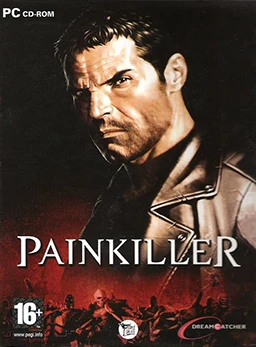
Hellstorm
Where Hell burns hottest, Pain walks through the fire and keeps walking.

Hellstorm is a campaign segment within the Painkiller first-person shooter franchise, developed by Flying Wild Hog. Set in the torrid, infernal planes of Hell, it follows the demon hunter Pain as he carves through waves of demonic foes in a gauntlet of fire, brimstone, and brutal close-quarters combat. The segment functions as a high-intensity stretch of the larger narrative, pushing Pain deeper into the heart of the demonic realm and escalating the stakes of his war against the forces that rule Hell.
As part of the broader Painkiller mythology, Hellstorm represents the raw, unfiltered fury of the infernal world—less a structured dungeon than a maelstrom of hellfire and writhing flesh. It is where the campaign's tone shifts from methodical progression to a relentless, almost fever-dream assault, embodying the franchise's signature blend of over-the-top violence and dark, mythic storytelling.
- Protagonist
- Pain (the Painkiller)
- Setting
- Hell / the infernal planes
- Developer
- Flying Wild Hog
- Genre
- First-person shooter with melee combat
- Primary weapons
- Hellfire Sword, firearms
- Antagonist type
- Demonic hierarchy of Hell
Lore & Background
In the Painkiller mythology, Hell is not a single place but a layered, shifting realm ruled by a demonic hierarchy. Pain, the eponymous Painkiller, is bound to this realm by a connection that is both curse and calling—he is part of Hell's own fabric, which grants him the strength to withstand its heat and the right to strike at its rulers. The Hellstorm campaign draws on this duality: Pain is simultaneously an intruder and a native, a weapon that Hell itself cannot fully control.
The infernal planes are depicted as landscapes of molten rock, rivers of liquid fire, and skies choked with ash and screaming souls. Demons populate every stratum, from lowly grunt-creatures to towering, multi-limbed warlords. The mythology frames Hell as a living organism whose rage is the Hellstorm itself—a cyclical eruption of fury that the demonic hierarchy channels and that Pain must cut through to reach the next objective. The storm is not merely weather; it is the emotional and spiritual residue of every soul trapped in the realm.
Pain's role in this context is that of a singular, almost mythic force: one figure, one sword, one will, moving against an infinite tide. The franchise's lore treats him less as a soldier and more as a natural disaster in human form, a counter-storm that Hell cannot extinguish because it is woven from Hell's own essence.
In Their Own Story
The sky above the obsidian plain is not a sky. It is a wound in the membrane of the world, weeping rivers of white-hot slag that hiss and crackle where they strike the black glass ground. Pain stands at the edge of a chasm, his sword dragging a furrow of molten light through the ash. The air tastes of iron and old blood.
A sound builds in the distance—not thunder, but a chorus. Ten thousand voices, none of them human, screaming in a frequency that makes his teeth ache. The ground shudders. From the chasm, they rise: shapes of flame and bone, eyes like cinders, mouths full of teeth that were once fingers.
He does not raise his sword. He never has to. It is already there, already hungry. The first one hits him and he is through it, a line of black ichor spraying across his face. He blinks it away. There are more. There are always more.
The storm closes in around him, a wall of fire and shrieking, and he walks into it. Not running. Walking. Because in Hell, running is for the ones who are still afraid, and Pain stopped being afraid a very long time ago.
Reader's Guide
The Hellstorm segment opens with Pain entering a region of Hell where the environment itself is hostile—ambient fire, collapsing terrain, and waves of enemies that spawn in continuous surges rather than discrete encounters. This design choice mirrors the narrative: the storm is not a place to be cleared but a force to be endured. The level layout is largely linear with occasional branching paths, reflecting Pain's singular purpose—he is not exploring; he is cutting a line through the realm.
Early encounters introduce the segment's enemy roster, emphasizing melee-focused demons that close distance quickly, forcing the player to manage the Hellfire Sword's stamina and the limited reload windows of the sidearm. Mid-segment, the pace shifts to arena-style confrontations where Pain must hold ground against mixed groups, using the environment's fire hazards as both threat and tool.
The segment's climax is a boss confrontation with a high-ranking demon who channels the Hellstorm's energy. Defeating this foe does not end the storm but breaks its concentration, opening a passage deeper into Hell. This ties into the broader campaign structure: each defeated hierarchy member strips a layer of Hell's defenses, and each storm broken reveals the next, more vulnerable stratum beneath.
Mythologically, the Hellstorm represents Hell's immune response—its rage made manifest. Pain's passage through it is not conquest but penetration, a needle threading through the heart of a living wound. The stakes extend beyond the level: if Pain falters, the storm reasserts, and the demonic hierarchy regains the cohesion it needs to organize a counter-offense against the mortal world. The campaign justifies its escalating difficulty by framing each wave as Hell's will reasserting itself against the one thing it cannot digest: Pain himself.
Did You Know?
- The Painkiller franchise's protagonist, Pain, is depicted as having a supernatural connection to Hell itself, which is why he can survive and fight within the infernal planes that would destroy a normal human.
- Flying Wild Hog, the Polish studio behind the Painkiller titles, built the franchise's identity around a hybrid combat system that blends fast-paced gunplay with a stamina-based melee sword system.
- The Hellfire Sword, Pain's signature melee weapon, is a recurring element across multiple entries in the franchise and is tied to the lore of Hell's own power being turned against its rulers.
- The Painkiller series has spanned multiple generations of hardware, with entries released from the early 2000s through the 2020s, each reinterpreting the core premise of one demon hunter cutting through Hell.
More in Story & Campaigns
Elsewhere in the Painkiller universe
Spotted an error? Know more?
This is a living reference — every entry is fact-audited, and reader corrections feed straight into our audit queue. Suggest an edit · See this site's audit record