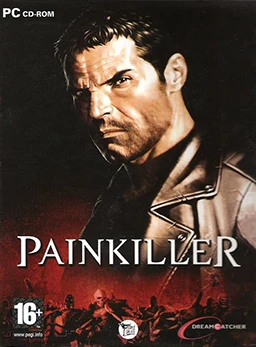
Hell Difficulty
You are already in Hell; now make Hell earn your respect.

Hell Difficulty is the most demanding difficulty setting in the Painkiller first-person shooter franchise, developed by the Polish studio People Can Fly. As the name implies, it is thematically anchored to the series' core setting: the player is already in Hell, and the game punishes hesitation, poor positioning, and wasted ammunition with a vengeance. It sits at the top of the standard difficulty ladder in multiple Painkiller titles and is intended for players who want the full, unfiltered brutality of the franchise's combat loop.
- Type
- Difficulty setting (hardest tier)
- Franchise
- Painkiller
- Developer
- People Can Fly
- Role
- Maximum-challenge mode; increases enemy aggression, health, and damage while reducing player resources
- Available in
- Multiple Painkiller titles across the franchise
Lore & Background
In the cosmology of the Painkiller universe, the protagonist is a warrior who has been thrust into the infernal realms to fight through waves of demons, fallen angels, and grotesque constructs of suffering. The very concept of a difficulty setting called 'Hell' is a meta-commentary baked into the design: the player is not merely fighting in Hell, they are fighting *as* Hell, subjecting themselves to the same relentless, suffocating pressure that the damned endure. Every extra demon, every tightened resource pool, every sharpened claw is the game reminding you that this is not a place where mercy is a mechanic.
In Their Own Story
The corridor reeks of sulfur and old blood. You round the corner and there are six of them—hunched, chittering, their eyes like molten coins. On Normal, you'd shotgun the first two and spray the rest. Here, the first one's claw catches your shoulder before your trigger finger finishes its arc, and the second is already on you, jaws wide, and the third is behind you. You feel the hit register, the screen pulse red, and you know—*know*—that if you miss the next spin, if you hesitate for a half-second to reload, the corridor becomes your grave and the sulfur smell becomes the last thing you ever notice. You spin. You fire. You survive. Barely. And the next corner is already dark.
Reader's Guide
Hell Difficulty in Painkiller titles operates as the top tier of the difficulty ladder. In practice, it scales enemy health, damage output, and often spawn density upward while tightening the player's resource economy—fewer health pickups, less generous ammo caches, and in some entries, a reduced or more fragile health pool. The core combat loop remains the same: fast, close-quarters brawling with a rotating arsenal of shotguns, blades, hammers, and special weapons, punctuated by spin attacks and finishing moves.
What makes it feel uniquely Painkiller is the interaction with the franchise's signature systems. The Pain meter or equivalent damage-feedback mechanic means that on Hell Difficulty, the window between taking a hit and being overwhelmed is razor-thin. You cannot afford to tank damage and wait for a combo; every enemy strike is a meaningful chunk of your health, and the enemy AI is tuned to close distance aggressively. Weapon-switching and spin attacks become not just stylish but *necessary* for clearing swarms before they lock onto you.
Compared to the 'Nightmare' or 'Insane' settings of other FPS franchises, Hell Difficulty in Painkiller leans less into slow, tactical attrition and more into sustained, high-tempo chaos. The challenge is not outthinking a single elite enemy; it is maintaining composure, resource discipline, and mechanical precision while being swarmed by dozens of fast, aggressive foes in a confined infernal space. It is the franchise's way of testing whether you can keep the party going when the music is a wall of screaming.
Did You Know?
- The Painkiller franchise is developed by People Can Fly, a Polish studio based in Warsaw, which has been behind the series since its inception in 2005.
- The franchise's setting in Hell makes 'Hell' as a difficulty label a deliberate thematic echo rather than a generic 'hardest mode' name found in many other shooters.
- Painkiller titles are known for a fast, brawler-style combat loop with spin attacks and weapon combos, a design identity that Hell Difficulty stress-tests by increasing enemy density and aggression.
- The franchise has spanned multiple entries across different publishers and engines, with the 2022 Painkiller serving as a modern reboot of the series.
More in Combat & Mechanics
Elsewhere in the Painkiller universe
Spotted an error? Know more?
This is a living reference — every entry is fact-audited, and reader corrections feed straight into our audit queue. Suggest an edit · See this site's audit record